


Keenan: Faith & Perspective & Seeing Everyone as Babies
- Trenton Phoenix
- May 3, 2025
- 5 min read


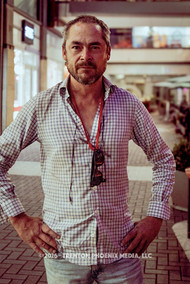







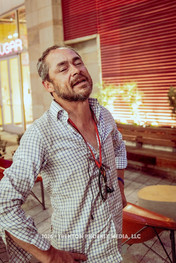
Name: Keenan Location: Denver, CO - 16th Street (Downtown)
Time: 9:53 PM Camera: Canon 6D Mark II Lense: Canon EF 24-105 MM 1.4 L IS USM
I met Keenan on a Sunday night in downtown Denver.
Or perhaps more accurately, he met me. I am unsure of how long he had been watching me.
I was sitting near an alley off 16th Street in Downtown Denver, my camera balanced low to the ground as I chased a photograph that wasn't cooperating. People moved in and out of the frame faster than I could compose it. The light was changing. The shot kept failing. A curious group of older people casually stopped right in the entrance of the alley, and lingered. They became aware of me, 20 feet across from them, and they still decided to linger haphazardly while I was waiting, ocationally making eye contact with me and geasturing my direction. I'm sure I looked strange to them, knelt down on the pavement across the street, with my big camera on the ground pointed at a weird direction.
Keenan wandered over to my right, and started talking. He was clean, and well dressed, and well mannered. He reluctantly complimented me on my "artistic vision". I figured, the older group wasn't keen on moving anytime soon, so I stood up and clicked my camera off and engaged with him. It would be the begging of a brief moment of tender mercy.
That is one of the peculiar gifts photography offers. The camera gives strangers permission to become something other than strangers. In the last 17 years that I have been taking photographs in public, I would wager, in some form or the other, that I have been approached several hundreds of times.
To give full weight and context to this experience, I need to be brutally honest with you about a facet of my charcter. I don't like being approached in public by strangers. Any strangers. My nervous system views the potential risk of an unknown person as too high, with too little possible benefit to take that risk. Over the years, I have learned to be more amicable and polite about saying "No, thank you." And turning possible interactions away. Even, on occasion, having to become abrupt and sternly distancing myself from someone.
Theirs another componet, too. Even older than my social anxiety or my Complex Post Traumatic Stress Disorder. From a very early age, I have felt uncomfortable with film and photographs that were taken at a time of crucial need, the subject being someone vulnerable. Starving babies that would die hours later. Victims of war, genocide, and starvation. I am not making a moral or a character judghement, but I simply never want to feel exploitative. I felt this way over a decade before I ever picked up my first camera, and years before I ever picked up a pen to write.
And yet... here we were.
As we began discussing art, I had an idea. At first, I only intended to make a portrait. A photograph. A name. Maybe a brief conversation. Polite. Non-invested. A slight detour of placation, and I would resume my attempts to capture this alley the way I had in my mind, devoid of a large group of older people starring at me as they occupy the lowest focal point of my architectural and lighting shot.

I never did return to try and finish this shot, my lighting window had vanished. In retrospect, a worthy sacrifice for a rare experience with another human.
To be perfectly honest, I didn't bring most of my gear with me on this trip. Including a decent audio recorder. Thats okay, it was a quick 2 day work trip in Denver, Steamboat Springs, on down past Colorado Springs to Pueblo, and back. I truly intended to just "play" with my camera gear in a realtively new city and stress test the hardware and settings. No big deal. I've done it a hundred times before.
Instead, I found myself standing on a sidewalk listening to a man describe faith, perspective, loss, and humanity with a wisdom that many people spend entire lifetimes pursuing.
After about ten minutes, I had asked Keenan if I could take a few photos of him, and record our convorsation. He became noticeably uncomfortable, and after discussing some boundaries and intentions, he gave me his consent, multiple times through out the next half hour.
I had to suffice with the Voice Memos App on my iPhone - the audio file is... of poor quality. But it is sufficent. And now, precious.
Keenan has been homeless for fifteen years. His belongings had been stolen three times that month alone. He told me he had discovered multiple dead bodies on the street in recent weeks.
Yet he spoke with a calmness that felt strangely out of place in the middle of downtown Denver.
When I asked what kept him going, he didn't hesitate.
His faith.
Not in the abstract sense. Not as a slogan or a political position. Faith as a daily practice of continuing forward when life gives you every reason to stop.
At one point he shared the old story about footprints in the sand.
The man who looks back at the hardest parts of his life and sees only one set of footprints.
"Lord," he asks, "why did you leave me?"
And the answer comes:
"I didn't leave you. I was carrying you."
It is a familiar story.
But familiar stories sometimes become familiar because they contain something true.
As we talked, another story emerged.
Keenan laughed and described the lobster aboard the Titanic.
For every passenger, the sinking of the ship was a tragedy.
For the lobster waiting to be cooked, it was salvation.
Perspective.
The same event.
Two entirely different realities.
The longer we spoke, the more I realized Keenan viewed much of life through that lens. Not as optimism. Not denial. Perspective.
He spoke about overstimulation and the weight of modern life. About too much noise. Too much information. Too many people adding their own droplets of paint to a canvas that already struggles to remain intact.
He described it better than I could.
Like watercolor.
At some point, too much water ruins the image.
Then he said something I have not stopped thinking about.
When he encounters people, regardless of who they are or how they live, he sees them as the babies they once were.
The addict on the sidewalk.
The wealthy executive.
The angry stranger.
The privileged person who has never known hardship.
All of them.
Somebody's baby.
Somebody who once took their first steps while a family celebrated.
Somebody who once made another human being smile simply by existing.
It is difficult to hate people when you look at them that way.
Not impossible.
But difficult.
As a veteran myself, parts of our conversation drifted toward trauma, hardship, and rebuilding. We spoke about loss. About starting over. About how some people break when life takes everything away.
Keenan has lost everything more than once.
Yet somehow, he still carries compassion.
Not because his life has been easy.
Because it hasn't.
Not because people have always treated him well.
Because they haven't.
But because he believes every person remains worthy of compassion regardless of their circumstances.
Before I left, I offered to buy him a drink.
Nothing dramatic.
Just a cold soda on a warm day.
As I walked away searching for a convenience store, I found myself thinking about why I started this project in the first place.
Photography freezes a moment.
Conversation reveals a person.
Most people who passed Keenan that day saw a homeless man sitting downtown.
I met a philosopher.
And for a brief moment on a Denver sidewalk, our paths crossed.
That conversation is now part of the journey.
Comments